Coring - at Last!
Published:November 2025
Sediment coring is a crucial step in palaeoecology, providing access to the layered record of past environmental change preserved in lake sediments. At the Three Lakes site in West Cork, recovering the first cores marks an important milestone in the project.
Surface sediment sampling (see Surface Sediment Coring) provides a modern comparison for interpreting deeper cores.
Recovering the sediment record for the first time
In our project timeline we had initially set May 2025 as the date for obtaining the crucial sediment core from the lakebed. For various reasons — though always because of other commitments on the part of other people — the date kept being put off. Summer holidays, of course, also intervened. For me, this being the big driving event, I would have made sure I was available to go coring at any time, but most especially while the weather was pleasant and conducive through the summer. October 17th — my birthday! — was finally settled on, but a back injury to a crucial member of the team postponed the date yet again.
It was November before the date was firmed up and it actually happened. The fear at this point, particularly after such a long dry and warm summer, was that by the 19th November the weather would have turned cold, wet, and stormy.
I know the lake so well. It is surrounded by a floating mat, and the most secure footing I had found for getting into the lake followed the course of the inflowing stream — there was plenty of sediment brought in by the stream. But with a single outlet stream to the north east, and with small, shallow, fairly choked channels between the lakes, water levels rise quite quickly with heavy rainfall and do not recede too fast.
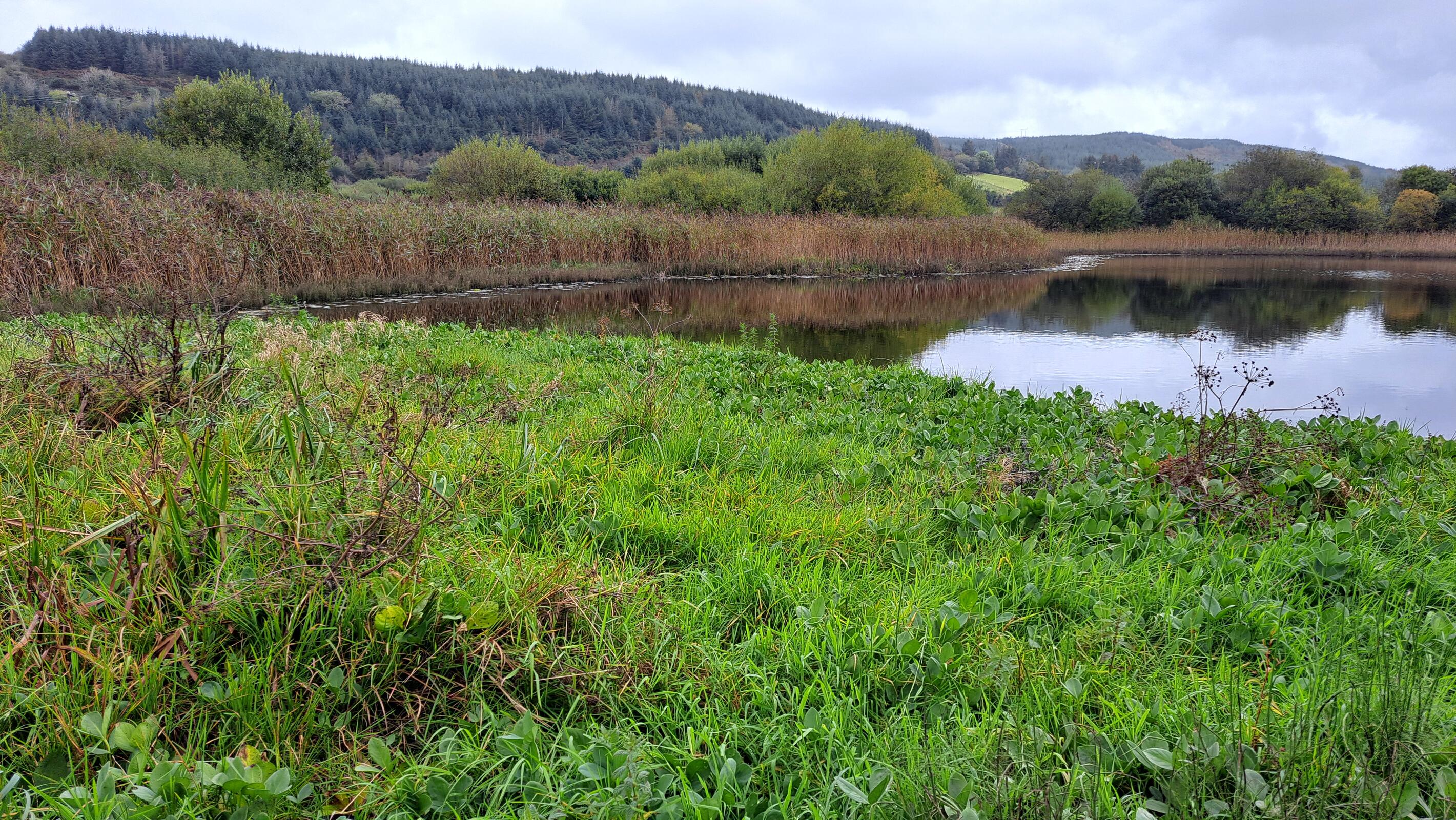

The lake has a shoreline submerged beneath a floating mat.
Well, the weather had turned cold, wet, and stormy. But amazingly both the 19th and 20th November were clear, sunny, and calm days — absolutely perfect weather for working knee-deep in the lake margin, out on the lake, and flying a drone. This turned out to be an exceptional bonus. It was an incredible break in the weather; the day after coring, the rain and wind returned.
The Team Assembles
We had managed to gather what turned out to be an excellent crowd of people to work as a team — nine of us altogether. Aaron and Karen brought the raft and coring equipment down from Galway. Andy and Sarahjane came down from Dublin. Michelle, Amanda, and Cathal drove down from UCC. Myself and my son Oscar were local.
Cathal brought the drone — he was to fly it if the weather was good enough. I had gathered together a lot of consumables — bags, pens, scalpels, chemicals, boxes, bins, tape, phials — most of which, as it turned out, we did not need. I also used the old Land Rover to bring over half a dozen wooden pallets to provide firm footing and spread the load; without some sort of support, feet generally sink into the wet ground.
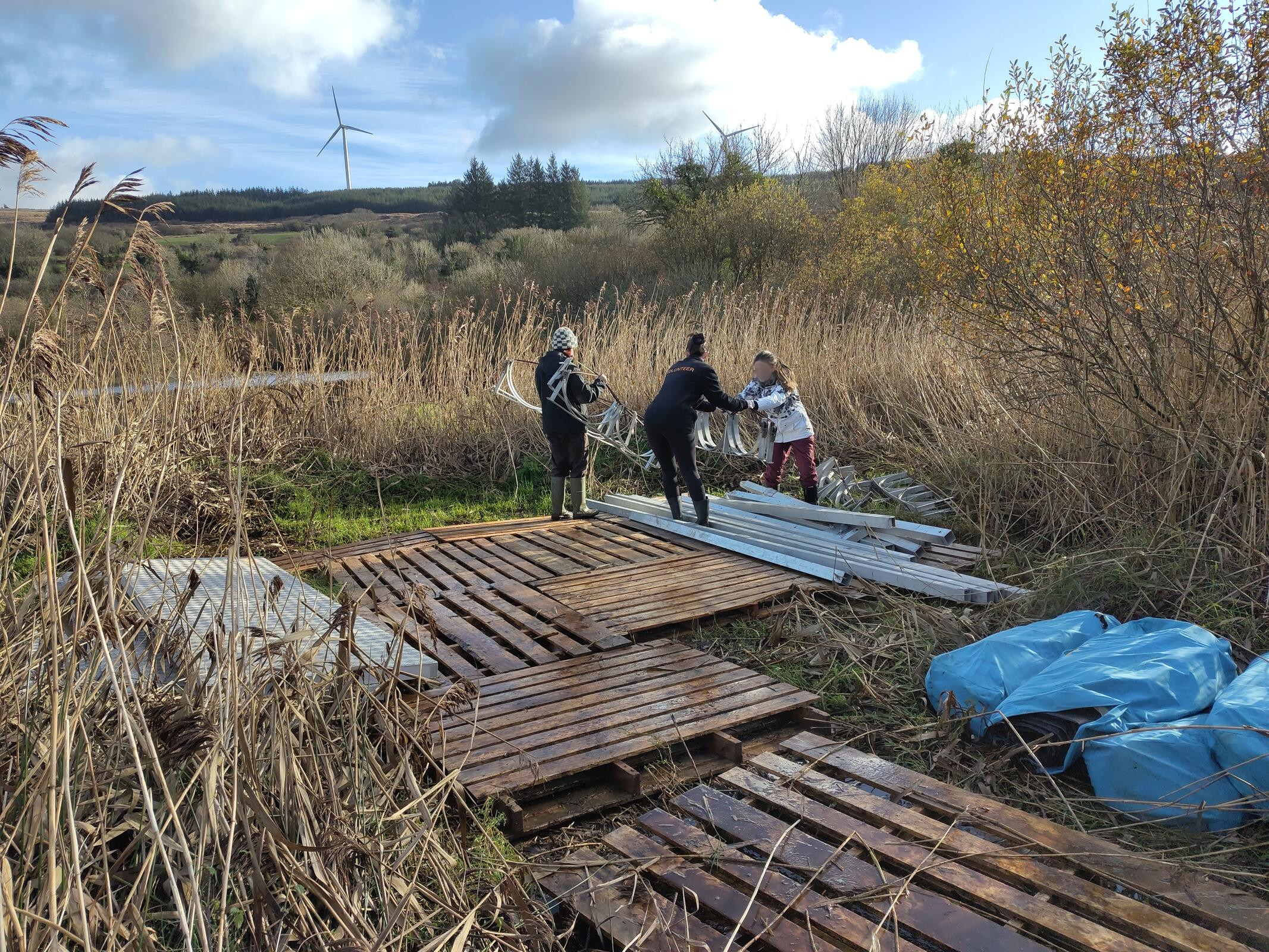
Starting to assemble the coring raft standing on pallets.
Preparing the Raft
We met at the lake at midday on Wednesday 19th. It was a clear blue sky with bright sunshine and autumnal warmth in the air. We spent the afternoon assembling the raft. After some trials we decided on an area of the floating mat where the distance both to open water and from the trailer was minimal.
We laid the pallets down and started assembling the raft. With only a couple of missed footings off the pallets — resulting in a soaking to the thigh — the afternoon went without a hitch, and by sundown the raft had been assembled, launched, and towed out.
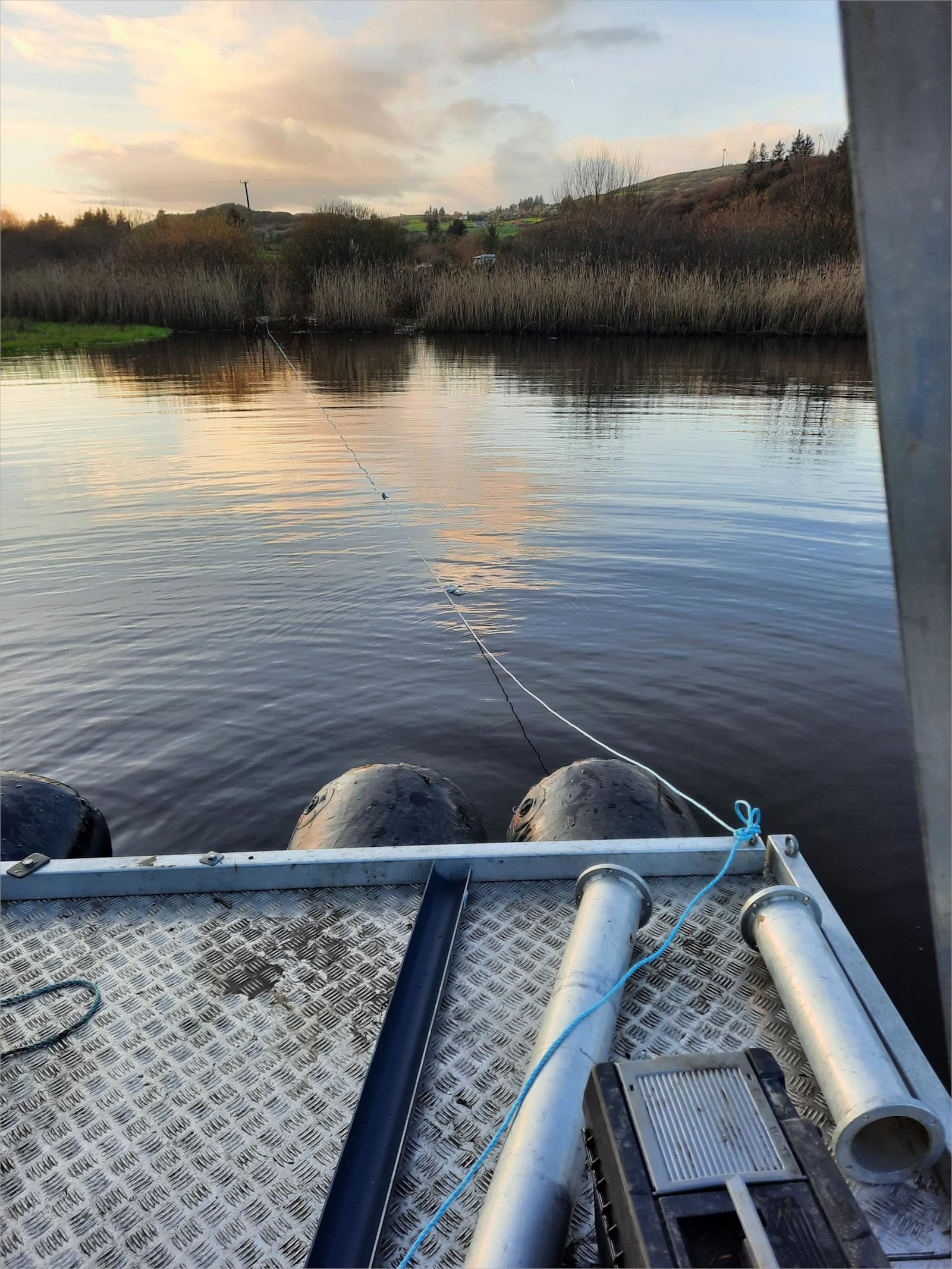
The coring raft launched on the lake.
That evening we met at the local pub in Drimoleague, where we had a meal, some fluid refreshment, and a most convivial gathering.
A Perfect Morning for Coring
The next morning dawned beautifully sunny, with well-frosted ground and a heavy local fog lying over the lakes. Cathal managed to get the drone up and took some stunning aerial photographs of the lake basin, looking north east over the eastern lake covered in fog, and south west over the big western lake.
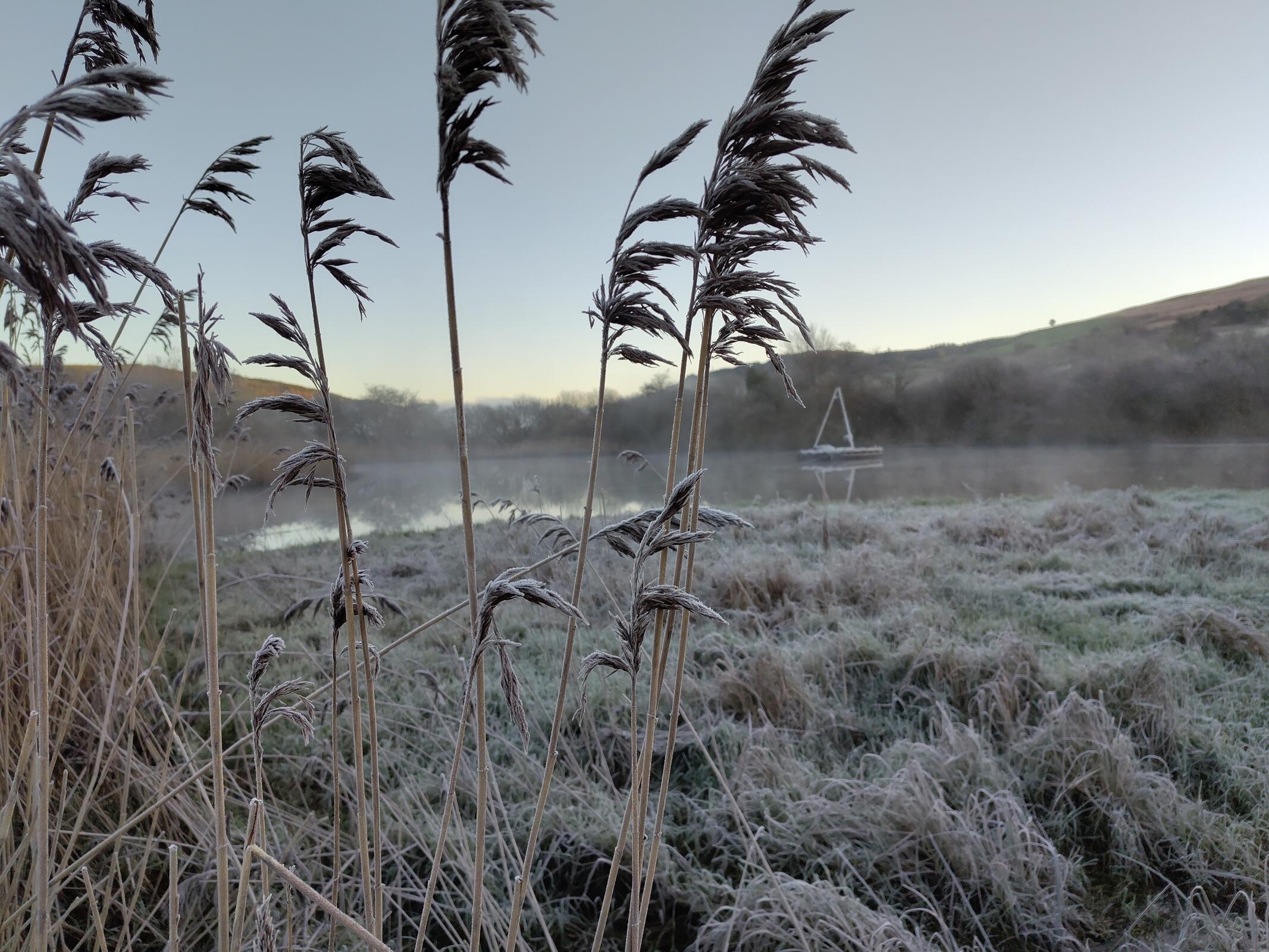

The raft in the early-morning frost (left); early-morning mist over the eastern lake (right).
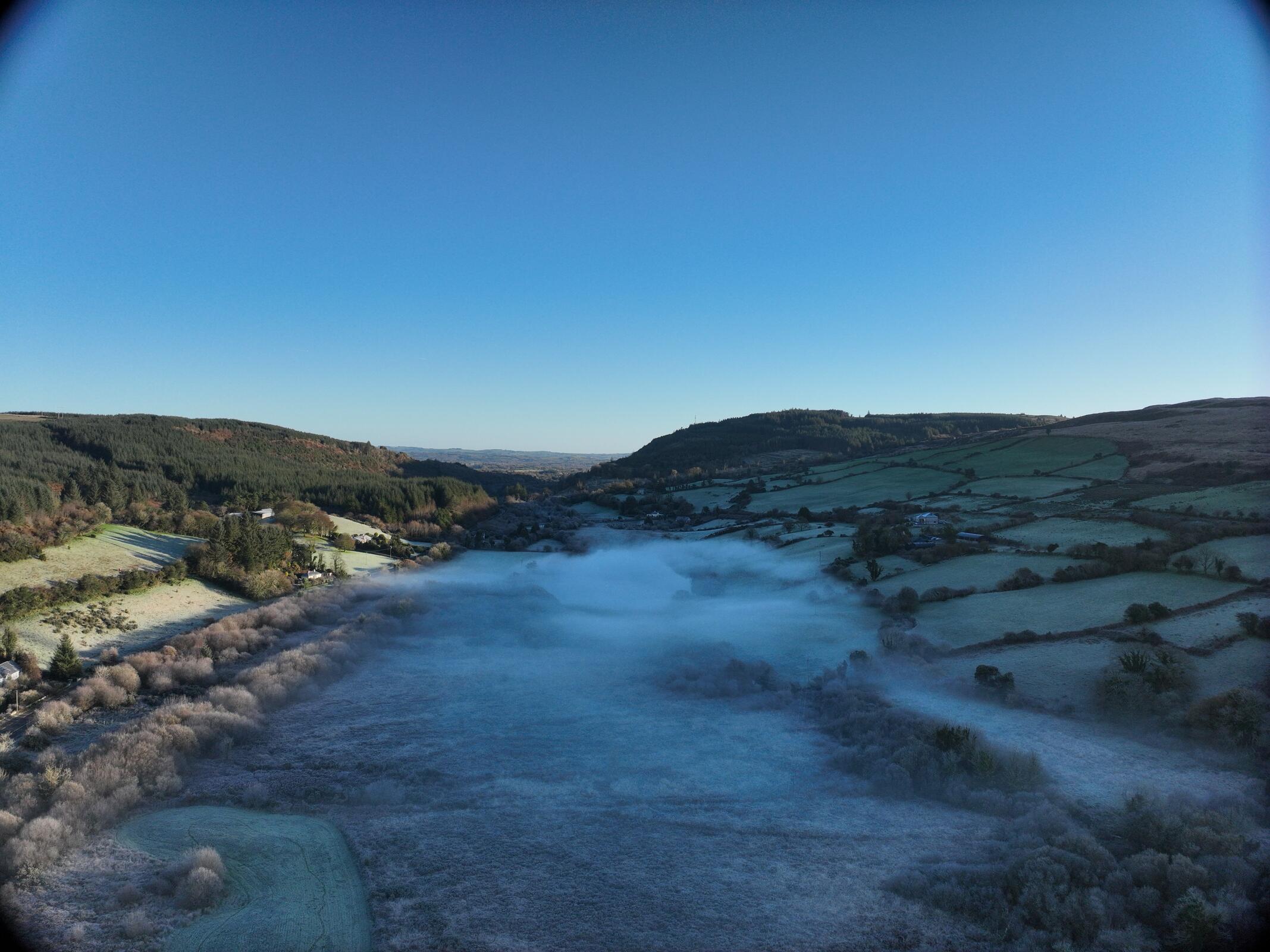

Aerial view in the early morning - looking east (left) and looking west (right).
Four of us went out to the raft to begin coring — myself, Aaron, Michelle, and Amanda. Oscar and Andy paddled about in the dinghy, ferrying people and cores to the shore, and Karen operated the extruder up by the vehicles. Several people moved from one team to the other as necessary.
The Coring Begins
The middle lake is shaped rather like a figure of eight, with two basins: the nearest almost circular, the further one much narrower. The raft was anchored by four ropes in a position central within the larger of the two lake basins, and the corer was directed down a tube that hung from the raft to the surface of the sediment. Thus we could be sure that every drive of the corer went down the same hole. It pulled out 2 metres of sediment in each drive. The water where we anchored was 3.6 metres deep.
In previous coring of this lake, we had tried near the centre of this basin and found only 3.5 metres of sediment before hitting stones. A second attempt near the edge of the floating mat gave 6.5 metres of sediment, but the top 2 metres were so fluid that we were not able to save them. Aaron and Karen’s experience assured us that the centre of the basin would give a good firm surface to the sediment, and we hoped for more than 3.5 metres depth.
The first two metres (0 to 1 and 1 to 2) came out, and when extruded we could see a consistent black-brown gyttja.

The first sediment core comes up.
The next two metres (2 to 3 and 3 to 4) — would we strike bottom? We didn’t — were also of a consistent dark organic colour, but with an interesting pale band at one point.
We drove the corer down for a third drive (4 to 5 and 5 to 6). At the bottom there was quite strong resistance, so we attached the “spokes” and two of us - the heaviest - jumped up and down on them to drive the corer down. This suggested to us that we had possibly found heavier sediment.
I accompanied this core back to where Karen would extrude it. As the extruder was ratcheted along, the bottom metre was extruded first. The first sight we had was of blue-grey clay, quite light in colour, and beginning to ooze away slightly. The top end of this metre — in reality about 60 cm — was dark organic gyttja, and slicing it in half exposed some beautiful layering.

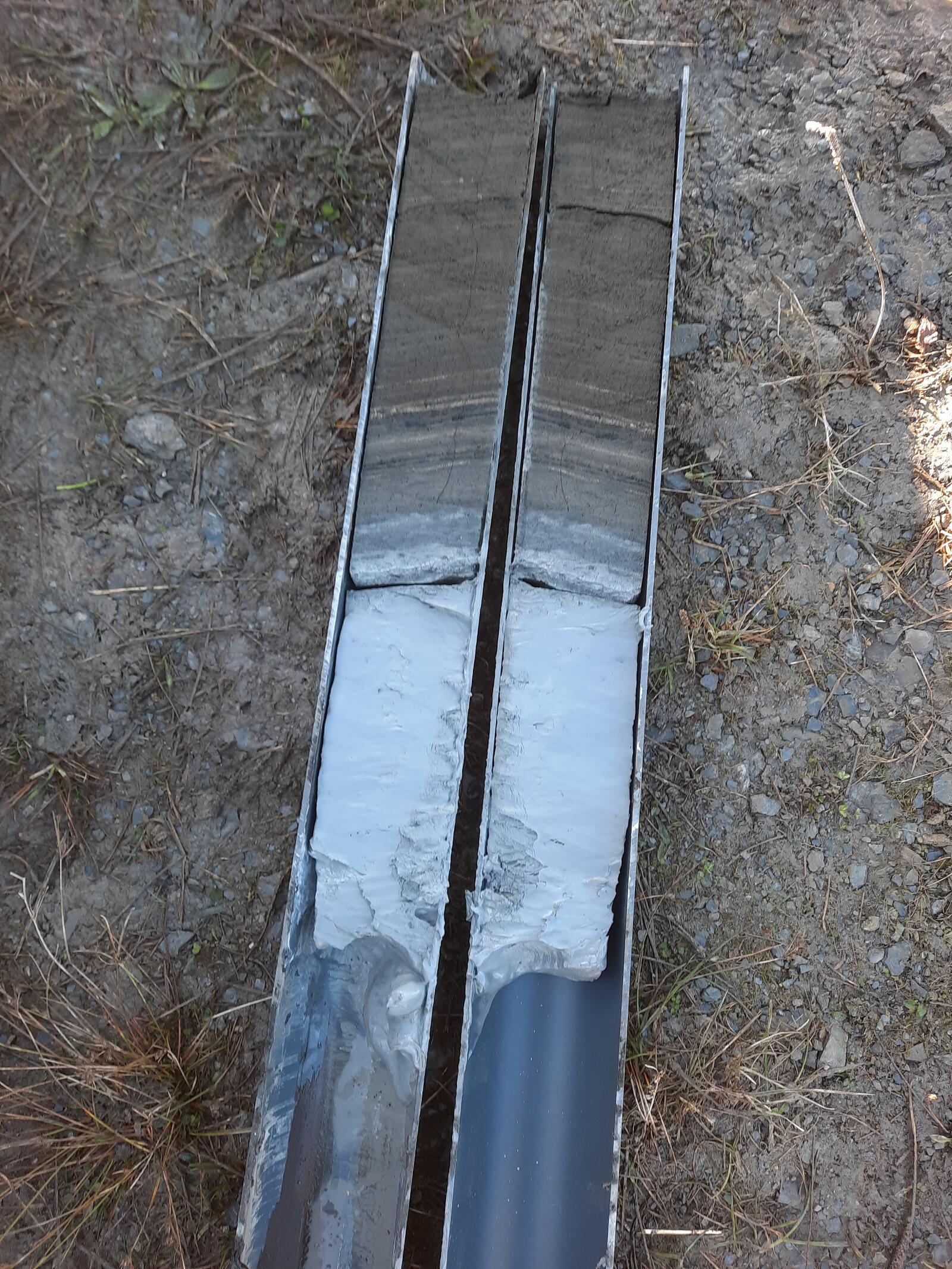
The bottom 61cm of the sediment core.
The Big Moment
The top metre of this core was the big one. We needed a good strong section that would show the Nahanagan Stadial (or Younger Dryas) termination. The whole metre was extruded and nothing was visible, but the sides of the core were smeared. Karen ran the wire through the middle of the metre while two of us held each side.
The suspense was hovering in the air around us.
We opened the core — and there was a most glorious sequence of coloured lines indicating sediment changes, including the main transition, at about 465 cm depth, from dark organic gyttja above to blue-grey clay below.
The Nahanagan Stadial termination.
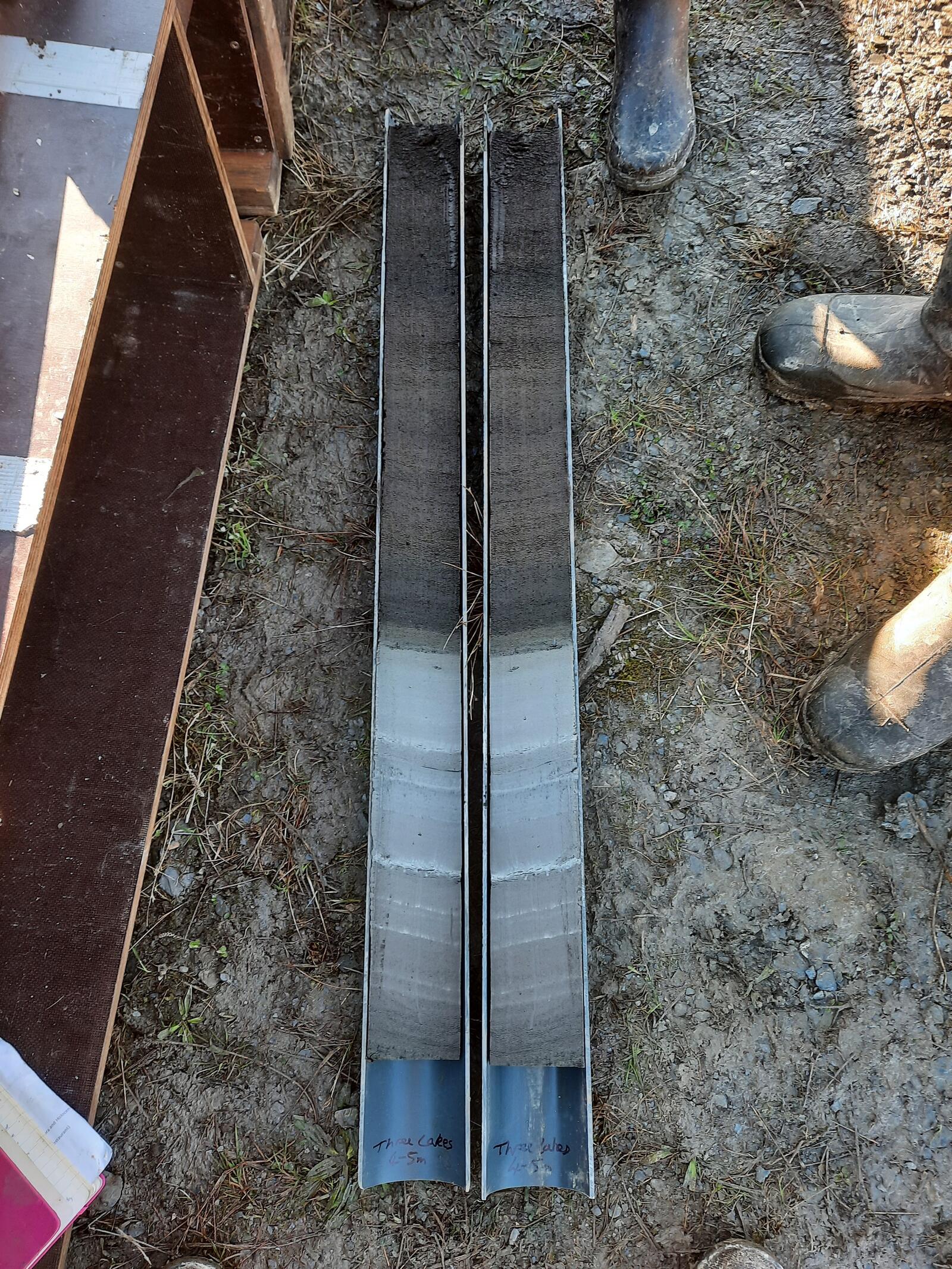
The Younger Dryas termination and below.
Michelle and Aaron had stayed on the raft in preparation for sending down another drive if necessary, or even worse, moving the raft and starting again. They were given the thumbs up, and so dismantling of the anchoring ropes, corer, tripod, and raft began.
One Regret
Only later did I regret this hurried dismantling. Potentially there was another metre or two — or more — of Late Glacial lacustrine clay further down. We would probably have had to use a smaller-bore corer, and it may have required a lot of force to get it down, but if we had retrieved another one, two, or even three metres, this may well have displayed varves or some other rhythmites.
I explore what use this could have been to us in a later blog, but the fact is that there are few varved sediments recorded from lakes in Ireland. We are breaking new ground here with our exploration of a lowland lake, with Late Glacial sediments continuous into the Holocene and up to the present, and in the south west corner of Ireland.
So what has been found — or not found — in Ireland to date will not necessarily be a good indication of what we are going to find here. Which makes this project particularly exciting.